
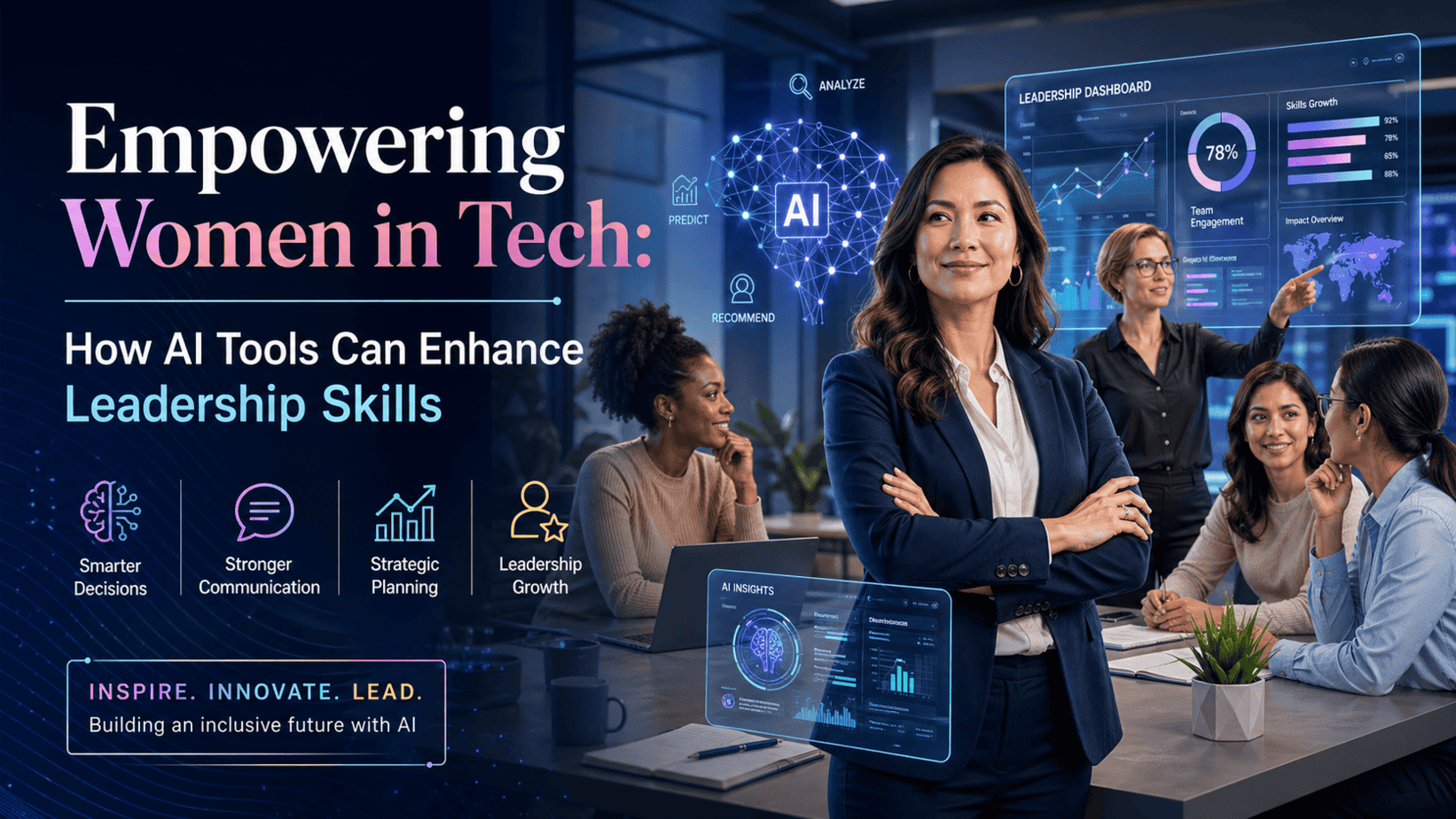
Empowering Women in Tech: How AI Tools Can Enhance Leadership Skills
30-Second Summary
- AI tools are revolutionizing leadership development for women in tech by offering personalized coaching, improving communication and emotional intelligence, enhancing decision-making, and fostering mentorship opportunities.
- These tools address the unique challenges women face in the industry, such as unconscious bias and a lack of female role models, by providing data-driven insights and continuous support.
- By integrating AI into leadership training, women in tech can break through barriers, build confidence, and rise to leadership positions, ultimately creating a more diverse and inclusive tech industry.
Introduction
The tech industry has long been recognized as a field dominated by men, with women facing numerous challenges in pursuing careers in this space. However, over the past decade, there has been a notable shift in the conversation about gender equality in technology. Women are making strides, but there is still significant work to be done to ensure that women have the support and opportunities to succeed and lead in tech roles. One of the most exciting developments in recent years is the use of artificial intelligence (AI) tools to empower women, particularly in enhancing their leadership skills. With the advent of AI-driven resources and personalized executive coaching for women, the landscape of women’s leadership in tech is being reshaped.
AI can play a pivotal role in breaking down traditional barriers and empowering women to rise to leadership positions by offering tailored insights, mentorship, and support. This article delves into how AI tools are reshaping the way women in tech are developing their leadership capabilities and how this innovation contributes to a more inclusive and diverse industry.
The Challenges Women Face in Tech Leadership
Before exploring the role of AI in enhancing leadership skills, it’s essential to understand the challenges women in tech typically encounter. For years, the tech industry has been predominantly male, with women often underrepresented in senior leadership roles. According to the National Center for Women & Information Technology (NCWIT), only 26% of computing-related jobs in the U.S. are held by women, and the figure shrinks even further for leadership positions.
Additionally, unconscious bias and gender stereotypes continue to plague women in tech. Women are often expected to exhibit leadership traits that align with traditional masculine ideals of decisiveness, aggression, and competitiveness, while their natural strengths, such as empathy, communication, and collaboration, are undervalued. These challenges create significant barriers to career progression and can diminish women’s confidence in their abilities.
The Role of AI in Leadership Development
AI tools are revolutionizing leadership development by providing personalized, data-driven feedback and strategies. These tools help individuals identify their strengths and weaknesses, learn from real-time analytics, and develop strategies for personal and professional growth. For women in tech, AI tools can be especially valuable in helping them overcome the challenges they face by delivering individualized coaching and guidance.
AI-powered platforms can assess leadership qualities, emotional intelligence, and communication skills, providing women with insights on how they can improve and grow in their roles. By identifying specific areas where a woman may need further development, AI tools can make the leadership journey more transparent and less intimidating. This personalized approach helps women feel more empowered and confident in their leadership potential.
Executive Coaching for Women in Tech: The Power of AI Integration
Executive coaching for women has long been recognized as a powerful tool for career development. Traditionally, executive coaching has involved one-on-one sessions with an experienced mentor or coach who provides guidance on leadership skills, decision-making, communication, and organizational dynamics. In recent years, AI has enhanced this form of coaching by adding a layer of customization and scalability.
AI-driven executive coaching for women allows for continuous, accessible guidance. Women in tech can use AI tools to receive feedback on their performance, track their progress, and receive personalized coaching suggestions without the constraints of time or geography. These tools can also simulate real-world leadership scenarios, enabling women to practice and hone their skills in a safe and controlled environment.
For instance, AI can analyze past leadership experiences and suggest strategies for better managing teams or negotiating with stakeholders. By leveraging these personalized coaching insights, women are empowered to make informed decisions and develop their leadership style based on data-driven advice.
AI Tools for Enhancing Communication and Emotional Intelligence
Effective communication and emotional intelligence (EQ) are crucial leadership skills that are often underestimated, especially for women in male-dominated fields like tech. AI tools focused on communication coaching can provide women with real-time feedback on their speech patterns, tone, and word choice. This is particularly helpful in honing public speaking skills, mastering presentation delivery, and navigating challenging conversations.
For instance, AI-based virtual assistants can analyze how women communicate in meetings, provide feedback on assertiveness, and help women become more self-aware of their communication style. These tools also provide strategies to enhance emotional intelligence, which is essential for leadership success. EQ is often regarded as a key determinant of leadership effectiveness, as it allows leaders to empathize with their teams, manage stress, and foster positive work relationships.
By using AI-driven EQ assessment tools, women can identify areas for growth and gain the self-awareness needed to improve their interpersonal skills. These tools also enable women to engage in more meaningful and authentic interactions with colleagues, build stronger networks, and gain respect in the workplace.
AI Tools for Leadership Decision-Making and Problem-Solving
Decision-making is at the core of effective leadership, and AI tools can significantly enhance this skill by providing women in tech with insights into how to approach complex decisions. AI can analyze vast amounts of data to offer women real-time recommendations on potential solutions, helping them navigate high-pressure situations and make more informed, strategic decisions.
AI tools also encourage women to embrace data-driven decision-making, which is crucial in the tech industry. For example, AI-powered platforms can track project outcomes, identify trends, and suggest strategies for improving team performance. By utilizing AI’s ability to process large datasets, women in tech can make more accurate and timely decisions, fostering greater confidence in their leadership abilities.
These AI tools are not only beneficial for personal decision-making but also for managing teams and driving organizational success. Women can use AI to assess team performance, identify skill gaps, and make strategic decisions about resource allocation, project management, and talent development. With AI’s assistance, women in tech can make decisions that lead to long-term success and innovation.
Mentorship and Networking Through AI
Mentorship has always been an essential component of leadership development, yet many women in tech struggle to find meaningful mentors due to a lack of female role models in the industry. AI is playing a transformative role in bridging this gap by enabling virtual mentorship platforms that connect women with experienced leaders, regardless of geographical location.
AI can match women with mentors based on shared career goals, skills, and interests, creating a personalized mentorship experience. These AI-driven platforms also facilitate networking by recommending potential connections, promoting professional development through online communities, and providing ongoing support. With these tools, women can overcome the challenge of finding a mentor and expand their professional network to include individuals who can guide them on their leadership journey.
The Future of AI in Women’s Leadership in Tech
As AI continues to evolve, its potential to empower women in tech will only increase. In the future, AI tools will become even more sophisticated, offering enhanced personalization and predictive insights. For example, AI could predict the next steps in a woman’s leadership journey, suggesting training, networking opportunities, or projects that will accelerate her career growth.
Moreover, AI-powered platforms may be integrated into everyday work environments, providing real-time feedback during meetings, presentations, or collaborative projects. This constant support will enable women to continuously develop their leadership skills in real-world settings.
Additionally, as more women enter the tech field and rise to leadership positions, AI will play an important role in amplifying their voices and promoting diversity in decision-making. By providing data-driven insights and enhancing leadership development, AI will be instrumental in creating a more inclusive and balanced tech industry.
Conclusion
Empowering women in tech is not just about providing equal opportunities; it’s about actively removing barriers and supporting women’s leadership growth through innovative solutions. AI tools offer personalized, accessible, and data-driven approaches to leadership development that help women overcome challenges in the tech industry. Whether through executive coaching for women, enhancing communication skills, aiding decision-making, or fostering mentorship, AI is transforming how women can lead and succeed in tech.
As AI continues to advance, it will play an increasingly critical role in ensuring that women not only participate in the tech industry but thrive in leadership positions. The future of women in tech is bright, and AI is helping light the way.